Competitor Finder
Map the full competitive landscape — direct, adjacent, and emergent — before the first IC.
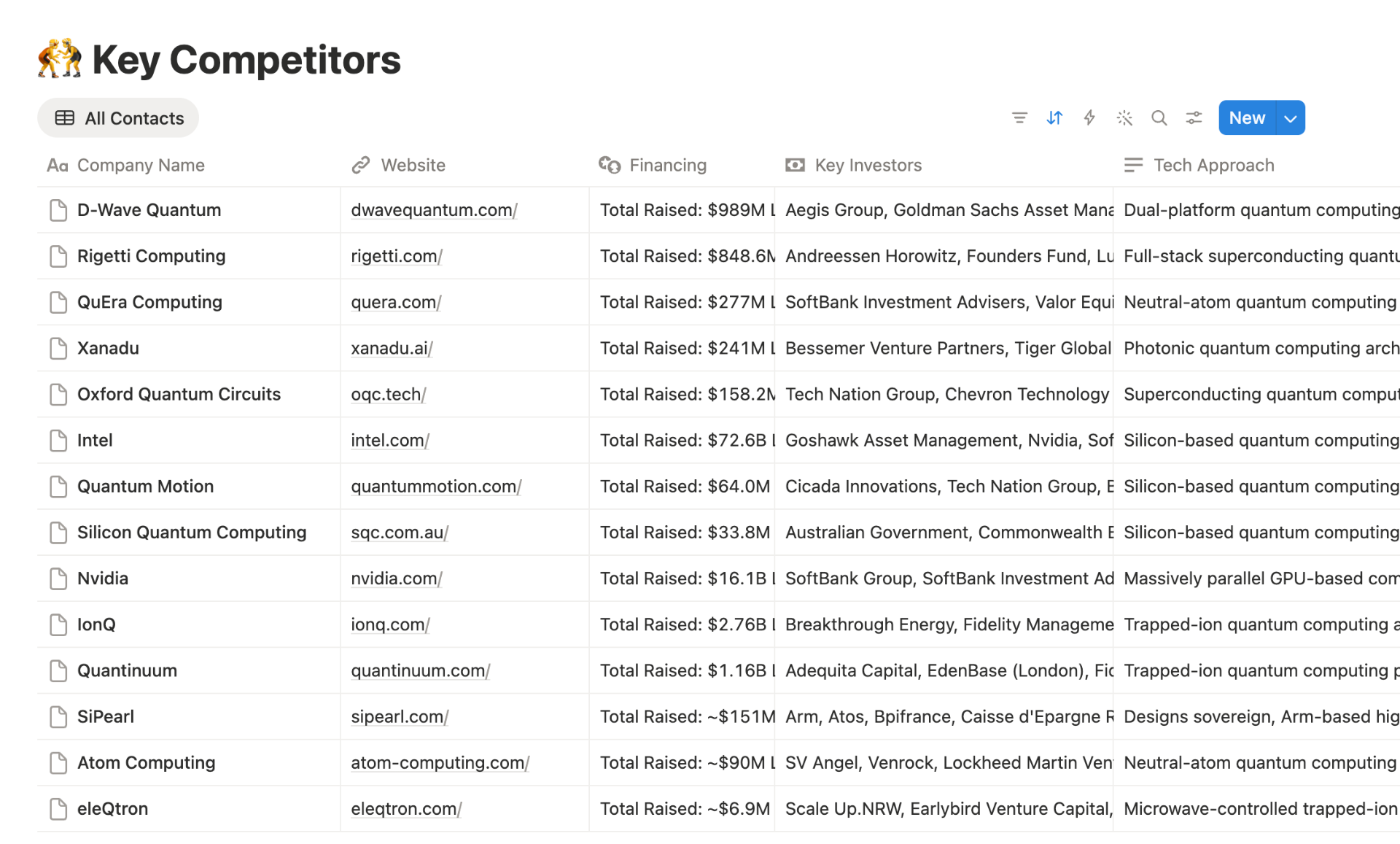
A bespoke AI workflow that lives as a sub-table on every company page in the pipeline. One click triggers a PitchBook 'similar companies' pull, then a fan out of model calls structures each result into a row the team can actually compare against the target.
What it does
The Competitor Finder is a small, opinionated tool that solves a specific bottleneck: the analyst hours lost to manually assembling competitor tables for every deal. Trigger it from the company page and the workflow runs end to end:
- Pull similars from PitchBook. Calls the competitor/similar-companies endpoint for the target company and retrieves the full candidate set.
- Enrich each candidate. For every returned company, fans out to a model with web-search and document tools to fill a standardized row: website, total raised, last round date, post-money valuation, key investors, technical approach, primary use case, and balanced pros / cons.
- Write back to the pipeline. Results land as rows in a sub-table on the company's deal page — collaboratively editable by the team, version tracked, and surfaced into the IC memo's Competitive Landscape section without rekeying.
The schema
Every row is the same shape. Standardization is what makes the table useful — for this deal, for the IC memo, and for every future competitor scan that benchmarks against this company.
| Field | What it captures |
|---|---|
| Company name | The competitor or adjacent player. |
| Website | Canonical URL — anchors all downstream enrichment. |
| Financing | Total raised, last round date, post-money valuation. |
| Key investors | Cap table signal — who else believes the thesis. |
| Tech approach | How they build — architecture, modality, differentiation. |
| Key use case | What they sell, to whom, today vs long-term. |
| Pro | The strongest argument for the company. |
| Con | The honest counter — risk, gap, or structural limit. |
Per row enrichment is driven by the Competitor Profile Builder prompt — it takes the PitchBook fact bundle for one similar company, researches the missing qualitative fields (tech approach, key use case, balanced pro / con), and returns them in a strict|||delimited shape so the next code step splits the response into the eight cells of the row without any LLM-aware parsing. The full orchestration lives in the Map Competitive Set automation.
Example output — Quantum target competitive scan
Six rows from a recent run on a quantum target. Each was assembled by the workflow from PitchBook + web in roughly the time it takes to make coffee; an analyst then reviewed and lightly edited before the IC.
D-Wave Quantum
dwavequantum.com- Key investors
- Goldman Sachs AM, Yorkville, Draper Associates, Bezos Expeditions, Fidelity, In-Q-Tel, Lockheed Martin Ventures, PSP Investments
- Tech approach
- Dual-platform superconducting strategy: large-scale quantum annealing for combinatorial optimization, plus an emerging gate-model roadmap on fluxonium qubits with on-chip cryogenic control. Hybrid solvers exposed via the Leap cloud platform.
- Key use case
- Near term production optimization — scheduling, routing, logistics, network and resource allocation across manufacturing, telecom, retail, government, and financial services. Longer-term materials science and fault-tolerant gate-model compute.
- Pro
- Only scaled, commercially deployed quantum systems delivering optimization value today; thousands of qubits via cloud with mature tooling; hybrid approach lowers adoption barriers.
- Con
- Annealing is specialized, not general purpose; long-term relevance depends on a successful gate-model transition; ongoing operating losses and capital intensity.
Rigetti Computing
rigetti.com- Key investors
- a16z, Founders Fund, Lux, Bessemer, DCVC, Battery, T. Rowe Price, In-Q-Tel, Palantir, Quanta Computer, Vy Capital, Y Combinator
- Tech approach
- Full-stack superconducting architecture with proprietary qubits, control electronics, and modular multi-chip processors connected via advanced packaging. Delivered through Quantum Cloud Services (QCS) for hybrid quantum-classical execution.
- Key use case
- NISQ-era algorithms — quantum simulation, optimization, and ML — primarily for government labs, academic institutions, and enterprise R&D exploring early quantum advantage.
- Pro
- Vertically integrated stack enables rapid hardware/software iteration; early leadership in multi-chip modular processors; cloud-based delivery lowers access barriers.
- Con
- Superconducting qubits face scaling, coherence, and error-correction challenges; performance still limited for commercial problems; capital-intensive roadmap with uncertain FTQC timelines.
QuEra Computing
quera.com- Key investors
- SoftBank, Valor Equity Partners, SBI Investment, Rakuten Group, Alphabet
- Tech approach
- Neutral-atom platform using arrays of laser-trapped atoms excited to Rydberg states. Qubits held in optical tweezers, programmable interactions via Rydberg blockade. Emphasis on analog and hybrid analog–digital computation.
- Key use case
- Quantum simulation of complex physical systems — materials science, chemistry, fundamental physics — plus analog exploration of optimization and ML-adjacent problems for research institutions and early enterprise.
- Pro
- Scales to large qubit counts faster than many gate-based approaches; high uniformity and long coherence; well-suited for analog simulation where near-term advantage is more plausible.
- Con
- Limited applicability to general-purpose FTQC vs digital gate-based models; analog reduces flexibility for arbitrary algorithms; path to error correction remains uncertain.
Xanadu
xanadu.ai- Key investors
- Bessemer, Tiger Global, In-Q-Tel, OMERS Ventures, Draper Associates, Pegasus Tech Ventures
- Tech approach
- Photonic quantum architecture on silicon photonics — light-based qubits at room temperature, modular scaling via optical fiber between chips. Pursuing fault tolerance through GKP photonic qubits, paired with PennyLane open-source stack.
- Key use case
- Long-term FTQC for quantum chemistry, materials science, optimization, and ML. Near-term: algorithm development, advantage demos, and enterprise/government R&D via cloud-accessible photonic systems.
- Pro
- Room-temperature operation and photonic networking offer a credible path to large, modular systems; strong hardware/software integration via PennyLane; clear roadmap to fault tolerance.
- Con
- Photonic QC is technically complex with significant loss-reduction and error-rate challenges; commercial timelines depend on FTQC at scale; long horizon to broad revenue.
Oxford Quantum Circuits
oqc.tech- Key investors
- Tech Nation, Chevron Tech Ventures, SBI Investment, Lansdowne, UTEC, IP Group, Oxford Science Enterprises, Parkwalk
- Tech approach
- Superconducting platform on the patented 3D Coaxmon architecture — extends the transmon into a 3D wiring/control scheme. Emphasis on noise reduction, coherence, scalable interconnects, and the transition from physical to error-corrected logical qubits.
- Key use case
- Commercially accessible quantum computing for enterprise and government — quantum chemistry, materials simulation, optimization, fraud detection, cybersecurity, and longer-term drug discovery and defense.
- Pro
- Differentiated 3D superconducting architecture targeting scalability and qubit quality; early emphasis on logical qubits over physical qubit counts; strong Oxford academic roots; cloud delivery lowers adoption friction.
- Con
- Superconducting still faces industry-wide error-correction and scaling challenges; capital-intensive roadmap with long FTQC timelines; unproven vs better-funded incumbents like IBM and Google.
Intel
intel.com- Key investors
- Nvidia, SoftBank Group, Third Point, Arthur Rock & Company, Glynn Capital, Venrock
- Tech approach
- Silicon-based spin qubits fabricated in advanced CMOS-compatible processes. Leverages leading-edge manufacturing, lithography, and process control for high-volume, high-uniformity qubit production, with cryogenic control electronics and system-level integration.
- Key use case
- Long-term scalable, fault-tolerant quantum computing; near-term research, materials science, and exploration of optimization and simulation as hardware matures.
- Pro
- Unmatched semiconductor manufacturing scale and process control; alignment with CMOS tooling and supply chain; potential cost/yield advantages at scale; deep system integration expertise.
- Con
- Spin-qubit performance and error rates lag some competing modalities; longer timeline to practical quantum advantage; significant R&D risk in scaling qubit counts while preserving fidelity.
Why this matters
Competitor tables are the part of diligence that quietly eats junior time and arrives at IC half finished. By codifying the schema and wiring PitchBook + AI directly into the deal page, the team gets a consistent landscape view on every deal and the firm builds a compounding internal corpus of structured competitive data that every future scan can reference.