Key Diligence Contact Finder
Surface the right customers, ex-employees, and domain experts to call for every deal.
The closing signal in diligence almost always comes from a human conversation — an investor, a former operator, a customer, a competitor who can place the company in context. This module is the bespoke AI workflow that surfaces those people, ranks them, and writes them straight into the deal record so the team can start outreach the same day.
The bottleneck
Reference calls are the one of the highest signal inputs in diligence. Few firms do them well at speed. The work is manual: cross checking LinkedIn against the cap table, hunting ex employees by tenure, mapping the firm's network for warm intros, chasing responses. By the time the calls land, the deal is often already priced. This module collapses that loop into a single trigger on the deal record.
How it works
- Trigger from the deal record. An analyst flips a single field on the company page in the CRM — “find contacts.” The system picks up the company name and any context already in the record (description, sector, leadership, investors) and kicks off the run. A start notification goes to the deal team so they know it's working.
- Fan out parallel retrieval against the firm's knowledge base. Five independent queries run in parallel against the firm's internal index of memos, call notes, newsletters, and prior diligence: investors, key people, former employees, customers, and competitors. This is where having Module 01 in place pays off — the better the corpus, the better the candidate list. Firms without a strong internal index can substitute web search and vendor data to start, then upgrade as the corpus grows.
- Extract candidates with an LLM pass. Each retrieval bundle is fed into a model that pulls out named people, their role, organization, and the reason they're relevant to this specific company — not generic experts, but contacts with a concrete tie to the deal.
- Rank, dedupe, and format. A second set of model passes ranks candidates by signal quality and proximity, removes duplicates across archetypes, and normalizes the output into a structured list — name, title, company, archetype, why-they-matter, suggested opening question.
- Write back into the deal record. Each contact is upserted as a row on a sub-table of the company page and mirrored into a firm-wide diligence call tracker. The team opens the deal and the contacts are already there, sortable, with the rationale attached. A completion notification closes the loop.
The five archetypes the workflow looks for
Cap table & prior backers
Existing and prior investors give the cleanest read on round dynamics, governance, and how the founder shows up behind closed doors.
Leadership & board
Executives and board members the team should know by name before the next call — including advisors and recent additions that signal where the company is heading.
Recent departures
Speaks to culture, execution, and operating cadence. A 12–36 month departure window gives the most candid, still-relevant read.
Current & churned users
Validates product love, retention, and the real-world pain being solved. Churned customers are the highest-signal call in the stack.
Adjacents & former competitors
Honest read on competitive dynamics, market structure, and what it actually takes to win the category.
Why it's built this way
Three design choices matter. Trigger from the deal record— not a separate app — so the contacts land back where the team already works and Module 03's data hygiene compounds. Fan out retrieval before generation — a single “find me contacts” prompt produces generic LinkedIn flavored slop; five focused queries against a real corpus produce specific, defensible names. Write structured output back into the CRM not a Slack message, not a doc, so the contacts become referenceable data for this deal and every future one.
You don't need an internal data lake to start
Worth flagging up front: a purely web based approach (no internal corpus, no proprietary vendor data, just an LLM with web access pointed at the right prompts) actually moves the needle here. It's genuinely good. Follow the prompts we'll link below and try it on a live deal; the candidate quality will probably surprise you. Internal data sharpens it over time, but the web only version is more than enough to get conviction-building conversations on the calendar this week.
Capture results in Notion (or your chosen collaborative workspace), templated per company
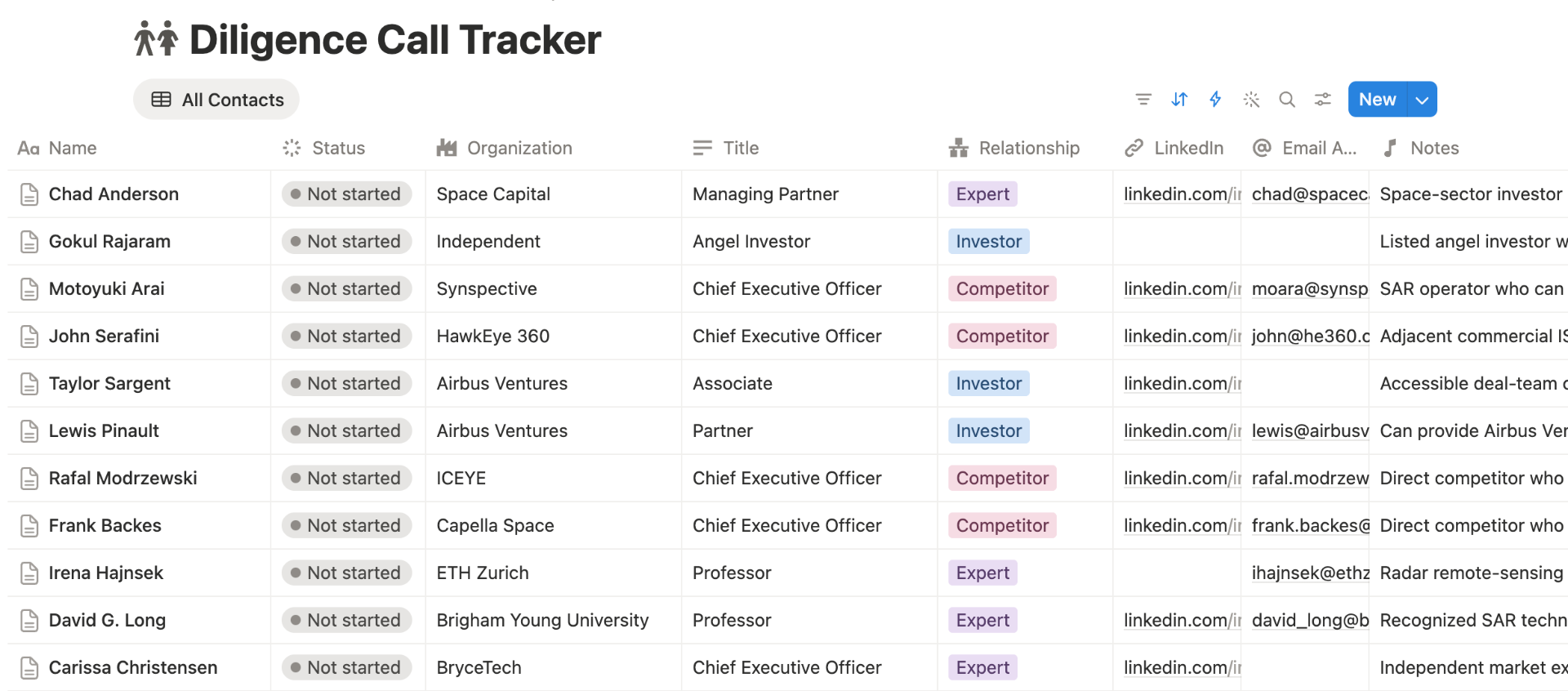
We land every run into a Notion database that's templated for each company in diligence. One row per contact, with a consistent schema so the team can sort, filter, and pick up where the last analyst left off. The fields we keep:
- Name
- Company
- Title
- Outreach status — not started, sent, replied, scheduled, done, no-go
- Rationale — why this person is worth a conversation for this deal
- Relationship — former employee, investor, board member, customer, competitor, advisor, etc.
- Notes
- Personalized outreach email — drafted per contact, ready to send
The time this saves is hard to overstate. Finding the right conversations is the single hardest step in getting a team to conviction; having a ranked, written-up, ready-to-email list sitting in Notion the moment a deal opens changes the cadence of the whole process.
Why this matters
Reference calls are where conviction gets made or broken. Firms that ship five sharp customer calls in the first week of diligence beat firms that ship two in week three every time. Automating the find and write back lets the team spend its hours on the calls themselves, not the hunt.